The Visual and Sonic Grandeur of Kathakali: An Analytical Treatise on Kerala’s Masterpiece of Performance
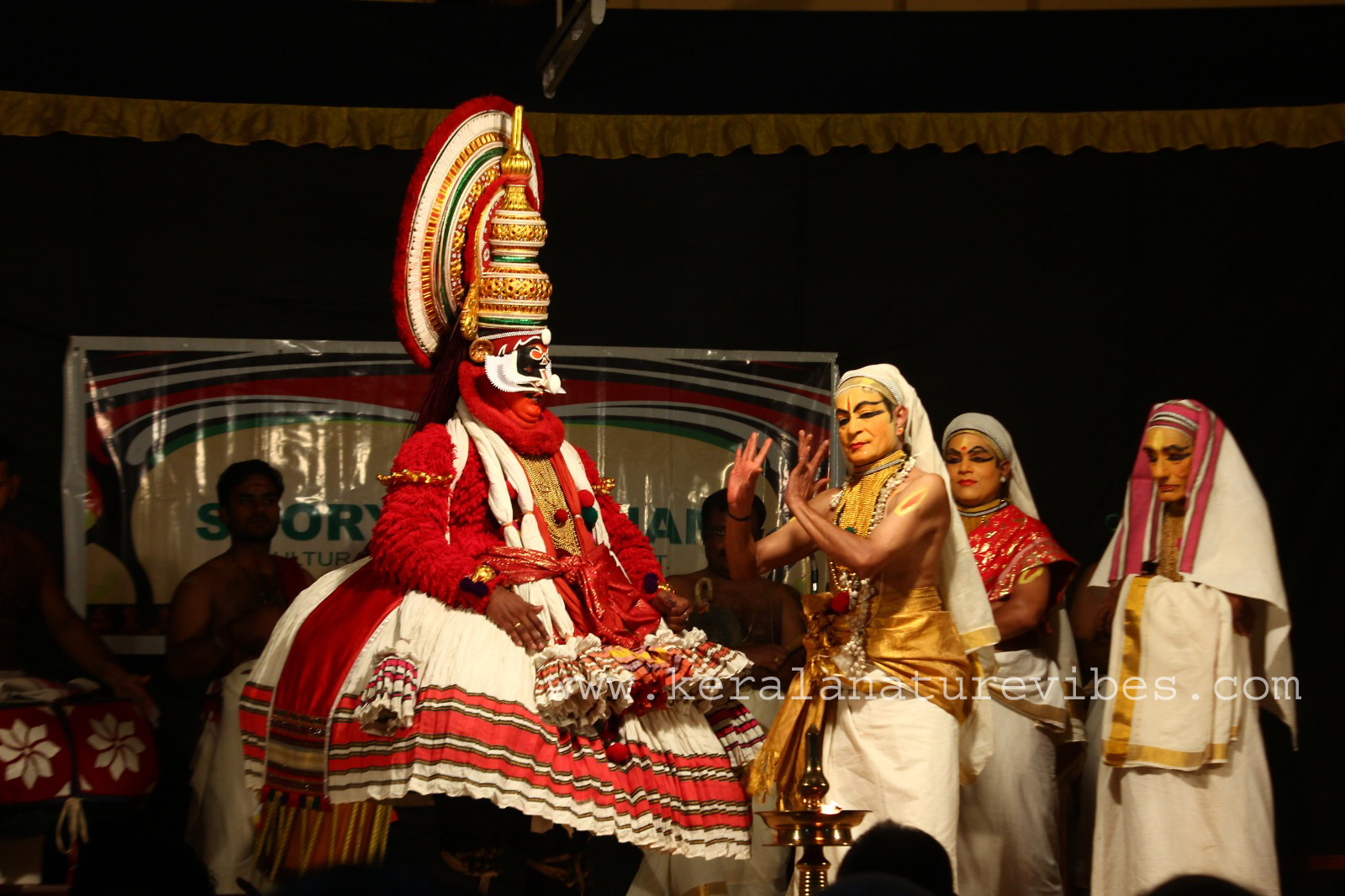
Kathakali Performance
Image courtesy: Arjun S Raj, Freelance Photographer
The southwestern coast of India, defined by its intricate backwaters and the lush slopes of the Western Ghats, is the cultural cradle of one of the most sophisticated theatrical traditions in the world. Kathakali—derived from the Malayalam words Katha (story) and Kali (play)—is not merely a dance form but a complete theatrical system that integrates literature, music, painting, acting, and dance into a unified narrative structure. Unlike many classical Indian dance traditions that evolved within temple environments, Kathakali developed under royal patronage and flourished in princely courts and martial training centers.
Recognized internationally as part of India’s intangible cultural heritage, Kathakali demands extraordinary physical endurance and emotional discipline. Training typically begins in childhood and continues for nearly a decade, focusing on body control, facial expression, eye movement, and the complex language of hand gestures (mudras) that replace spoken dialogue. This synthesis of visual symbolism and kinetic storytelling has made Kathakali one of the most visually powerful performance traditions in the world (UNESCO; Kerala Kalamandalam).
For travelers and culture enthusiasts visiting Kerala, witnessing a live Kathakali performance offers an unforgettable cultural experience. You can explore accommodation options through
Booking.com
or discover authentic traveler reviews and local recommendations on
Tripadvisor.
Those seeking a curated cultural experience may consider a guided
Kochi Kathakali performance tour via Viator.
The Historical Crucible: From Ritual to Courtly Drama
The origins of Kathakali represent a layered cultural evolution rather than a single moment of creation. Its structural foundations draw from the Sanskrit theatre tradition of Koodiyattam and ritual performance forms such as Theyyam, Padayani, and Mudiyettu. These earlier traditions contributed key elements including elaborate facial painting, the central oil lamp (nilavilakku) as the focal stage light, and the use of hand gestures to communicate narrative content.
A decisive turning point occurred in the 17th century through a well-documented cultural rivalry between the Zamorin of Calicut and the Raja of Kottarakkara. The Zamorin had patronized Krishnanattam, a Sanskrit dance-drama based on the life of Krishna. When a request to perform it in Kottarakkara was refused, the Raja responded by composing Ramanattam, an eight-play cycle narrating the Ramayana. Crucially, this new form used a Sanskritized Malayalam, making the performance accessible to regional audiences and laying the linguistic foundation for Kathakali.
In the 18th century, the scholar-king Kottayathu Thampuran expanded the repertoire to include episodes from the Mahabharata. His four celebrated works—Kirmeeravadham, Bakavadham, Nivathakavacha Kalakeyavadham, and Kalyanasougandhikam—remain central to the modern performance tradition. Later, Kaplingad Narayanan Namboothiri standardized costumes, makeup, and performance grammar, transforming Kathakali into a highly codified classical art.
Historical Figure
Contribution to Kathakali
Primary Significance
Zamorin of Calicut
Patronage of Krishnanattam
Established a ritualistic predecessor to Kathakali
Raja of Kottarakkara
Creation of Ramanattam
Shifted language to Malayalam and introduced the eight-play cycle
Kottayathu Thampuran
Composed the four Kottayam plays
Integrated Mahabharata themes and refined choreography
Kaplingad Narayanan Namboothiri
Reformer and aesthete
Standardized costume and makeup traditions
Vallathol Narayana Menon
Founded Kerala Kalamandalam
Revived and institutionalized Kathakali in the 20th century
The Architecture of Identity: Vesham and the Chutty Technique
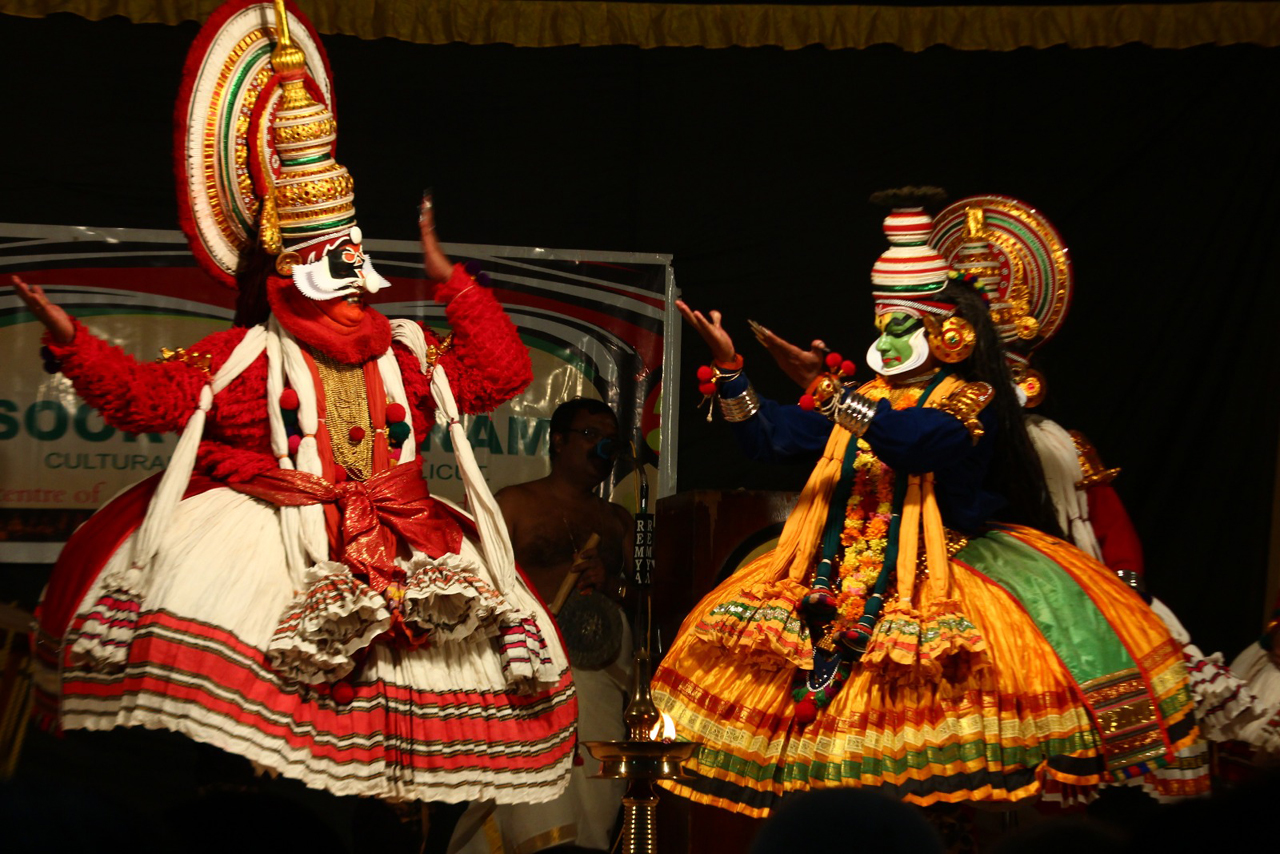
Kathakali Performance
Image courtesy: Arjun S Raj, Freelance Photographer
In Kathakali, the performer’s body becomes a symbolic canvas. The elaborate costume and makeup system—collectively known as Vesham—communicates a character’s ethical nature, emotional temperament, and spiritual status even before the performance begins. The transformation process itself is a ritual discipline called Chutty, often lasting up to five hours.
Traditional makeup materials are derived from natural and mineral sources. Yellow tones are produced from raw sulfur, blue and black from indigo and carbon mixtures, while a paste of rice flour and lime forms the distinctive raised white frame around the face known as the Chutty. Mixed with coconut oil, these pigments remain stable under the heat of oil lamps and the physical strain of all-night performances.
The Five Canonical Veshams
Kathakali characters are grouped into distinct visual categories, each defined by color symbolism and ornamentation that reflects moral and psychological attributes.
Pacha (Green)
The Pacha category represents noble and spiritually evolved heroes such as Rama, Krishna, and Arjuna. The green face symbolizes harmony between moral virtue and heroic strength. Characters wear elaborate crowns (Kireetam) or divine headgear (Mudi).
Kathi (Knife)
Kathi characters combine nobility with arrogance or moral corruption. Their green base makeup is marked by red streaks and white protrusions, reflecting internal conflict. Ravana and Duryodhana are classic examples.
Thadi (Beard)
This category includes three subtypes: Chuvanna Thadi (Red Beard) for violent demonic characters, Vella Thadi (White Beard) for divine beings such as Hanuman, and Karutha Thadi (Black Beard) for wild or primitive figures.
Kari (Black)
Reserved for demonic female characters, Kari makeup features jet-black faces with striking red and white patterns symbolizing chaos and destructive energy.
Minukku (Radiant)
Minukku represents gentleness, devotion, and spiritual refinement. Used for women, sages, and Brahmins, it employs soft yellow or orange tones without heavy facial framing.
Vesham Type
Moral Quality
Key Visual Features
Character Examples
Pacha
Satvik (Virtuous)
Solid green face, white Chutty
Rama, Krishna, Arjuna
Kathi
Rajasik (Arrogant)
Green face with red slashes and white knobs
Ravana, Duryodhana, Kamsa
Chuvanna Thadi
Tamasik (Ferocious)
Red beard with bold red/black patterns
Dussasana, Bakasura
Vella Thadi
Divine
White beard and facial patterns
Hanuman
Karutha Thadi
Scheming/Wild
Black beard and dark facial design
Kali, forest hunters
Kari
Demonic
Jet-black face and costume
Surpanakha, Simhika
Minukku
Gentle/Spiritual
Soft yellow/orange tones, minimal ornaments
Draupadi, Damayanti, sages
The Silent Lexicon: Mudras and the Grammar of Gesture
In Kathakali, the actor does not speak. The narrative text is sung by vocalists, while the performer translates the meaning into a sophisticated visual language. This translation is governed by the Hastalakshana Deepika, the authoritative manual that codifies the system of hand gestures known as Mudras. Although there are only 24 primary mudras, their combinations—along with variations in hand position, arm movement, body posture, and facial expression—allow the representation of more than 470 words, ideas, and narrative situations.
Mudras are classified into Asamyutha (single-hand gestures) and Samyutha (double-hand gestures). Precision is essential: even a slight change in finger angle or wrist orientation can alter meaning dramatically. Through this refined gestural grammar, actors conduct extended silent dialogues, narrate complex emotional exchanges, and communicate philosophical ideas without spoken words.
The 24 Primary Mudras of the Hastalakshana Deepika
Mastery of these gestures enables performers to depict everything from cosmic landscapes to subtle emotional states.
- Pathaaka (Flag): Sun, king, elephant, lion, or earth.
- Mudraakhyam: Growth, heaven, ocean, or forgetting.
- Katakam (Golden Bangle): Vishnu, Krishna, gold, silver, or mirror.
- Mushti (Fist): Strength, beauty, purity, or charioteer.
- Kartharee Mukham (Scissor’s Point): Brahmin, house, child, or hunger.
- Sukathundam (Parrot’s Beak): Bird or engagement.
- Kapidhakam (Fruit): Net, doubt, or touching.
- Hamsapaksham (Swan’s Wing): Moon, protection, arrival, or salutation.
- Sikharam (Peak): Eyes, search, or path.
- Hamsaasyam (Swan’s Beak): Mercy, compassion, or the beginning of rain.
- Anjaly: Worship and reverence.
- Ardhachandram (Half Moon): Spear, meditation, or prayer.
- Mukuram (Mirror): Mirror or beauty.
- Bhramaram (Beetle): Wing, fear, or song.
- Soochimukham (Needle’s Point): Number one, sun, or knowledge.
- Pallavam (Sprout): Smoke, eye-length, or distance.
- Thripathaaka (Triple Flag): Sunset or begging.
- Mrigaseersham (Deer’s Head): Deer or the Supreme Being.
- Sarpasirassu (Serpent’s Head): Snake or slowness.
- Vardhamanakam (Seedling): Jewel chain or well.
- Araalam (Curved): Tree, bud, or ignorance.
- Oornanabham (Spider): Horse, tiger, or snow.
- Mukulam (Bud): Monkey or fading.
- Katakaamukham: Servant or the release of an arrow.
Netrabhinaya and the Theory of Navarasam
While the hands provide the vocabulary of Kathakali, emotional depth emerges through Rasaabhinaya. The performer’s face functions as an expressive mirror of inner psychological states. This expressive system is built upon the theory of the Navarasas—the nine fundamental emotions that structure classical Indian aesthetics.
These emotions include: Sringaram (love), Veeram (heroism), Hasyam (laughter), Roudram (anger), Karunam (compassion), Bhayanakam (fear), Bibhatsam (disgust), Adbhutan (wonder), and Santam (tranquility). Actors undergo intensive training to control individual facial muscles and to shift rapidly between emotional states.
A critical component of this technique is Netrabhinaya—expression through the eyes. To enhance visibility from a distance, performers traditionally use the seed of the Chundapoovu plant to redden the eyes, creating a striking contrast against facial makeup and intensifying the dramatic effect under stage lighting.
The Rhythmic Foundation: Sopana Sangeetham and Percussion
The musical tradition of Kathakali belongs to a distinctive Kerala genre known as Sopana Sangeetham. Originating in temple rituals, this style is slow, deeply rhythmic, and devotional in character. Named after the sacred steps (Sopanam) leading to a temple’s sanctum, the music supports the dramatic mood rather than dominating the performance.
Specific ragas such as Indalam, Samantha Malahari, and Puranceru are selected to match the emotional tone of each scene. The ensemble typically includes two singers and multiple percussionists.
The lead vocalist, known as the Ponnani, controls the performance rhythm while playing the Chengila (gong). The assistant, the Shinkiti, provides vocal support and plays the Ilathalam (cymbals).
Percussion reflects the martial energy of Kathakali. The Chenda, a powerful vertical drum, accompanies heroic and dramatic entrances. The Maddalam, a barrel-shaped drum played with the hands, provides rhythmic depth throughout the performance. For gentle Minukku characters and softer sequences, the Chenda is silenced and replaced by the delicate Idakka, preserving the graceful aesthetic of Lasya.
The Rigorous Path of Training: Kalamandalam and Uzhichil
Becoming a Kathakali artist requires years of disciplined training, typically lasting between eight and twelve years. The most prestigious center for this training is Kerala Kalamandalam, founded by the poet Vallathol Narayana Menon. Instruction follows the traditional Guru–Shishya system, where students live and train under the close supervision of masters.
One of the most demanding aspects of training is Uzhichil, a specialized Ayurvedic oil massage technique. Conducted especially during the monsoon season, this practice enhances flexibility, strengthens muscles, and prepares the body for the demanding semi-squatting stance known as Mandalam.
This physical discipline is closely connected to Kalaripayattu, Kerala’s ancient martial art, which contributes to the dynamic jumps, leg extensions, and powerful body control characteristic of Kathakali performance.
The Repertoire: Timeless Narratives of Gods and Men
Kathakali plays, known as Attakatha, draw primarily from the Indian epics and Puranic literature. These narratives are widely familiar to audiences; the artistic pleasure lies not in suspense but in the interpretative brilliance of the performer.
Masterpieces of the Kathakali Stage
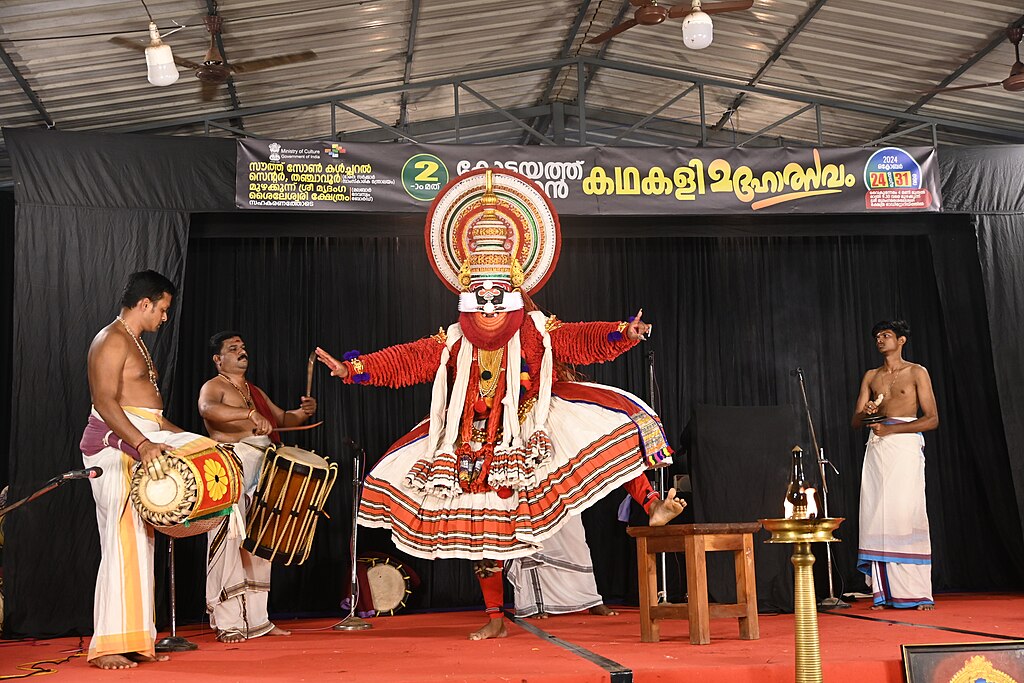 Kalyanasaugandhikam, Kathakali Performance at Mridanga Saileswari Temple
Courtesy: Vinayaraj, CC BY-SA 4.0
Kalyanasaugandhikam, Kathakali Performance at Mridanga Saileswari Temple
Courtesy: Vinayaraj, CC BY-SA 4.0 , via Wikimedia Commons
Play Name
Theme/Epic
Central Conflict
Notable Features
Kalyanasougandhikam
Mahabharata
Bhima’s quest for the celestial fragrance flower
Includes the symbolic meeting between Bhima and Hanuman
Nalacharitham
Mahabharata
The separation and reunion of Nala and Damayanti
Renowned for emotional depth and lyrical beauty
Duryodhana Vadham
Mahabharata
Bhima’s killing of Duryodhana
Highly dramatic sequences and intense character conflict
Kiratham
Mahabharata
Arjuna’s encounter with Shiva disguised as a hunter
Striking contrast between heroic and wild character types
Keechakavadham
Mahabharata
Bhima’s slaying of Keechaka
Emphasizes the protection of Draupadi’s honor
Karnaasapatham
Mahabharata
Karna’s tragic realization before battle
Explores themes of loyalty, fate, and moral conflict
The Tourist Experience: Planning a Visit to the Kathakali Stage
For the modern traveler, experiencing Kathakali in Kerala is one of the most memorable cultural encounters. While traditional temple performances often continue throughout the night, cultural centers in major tourist destinations now offer curated one-hour presentations that include explanatory sessions and demonstrations of facial expressions and mudras.
Travelers planning their Kerala itinerary can explore accommodation and travel options through
Booking.com
or browse visitor reviews and cultural recommendations on
Tripadvisor.
These platforms help identify performance venues, nearby stays, and the best cultural experiences across the state.
Strategic Venues for Travelers
Kochi—particularly Fort Kochi—is the most accessible destination for high-quality Kathakali performances. The Kerala Kathakali Centre near Santa Cruz Basilica is widely respected for its daily shows featuring artists trained at Kerala Kalamandalam. The Cochin Cultural Centre offers a similar program with English narration, making it especially valuable for international visitors seeking to understand the symbolic language of the performance.
Visitors who prefer a guided cultural experience that combines sightseeing with a live performance may consider a curated tour such as
this Kochi Kathakali experience on Viator, which integrates city heritage with an evening performance.
For a deeper and more academic engagement, a visit to Kerala Kalamandalam at Cheruthuruthy offers rare access to training sessions (Kalaris) and insight into the discipline that sustains the tradition. In the hill regions of Munnar and Thekkady, venues such as Punarjani Traditional Village and Mudra Cultural Centre present intimate performances, often paired with demonstrations of Kalaripayattu.
Traveler’s Protocol and Etiquette
Attending a Kathakali performance involves observing certain cultural practices. Visitors are encouraged to arrive at least one hour before the performance begins in order to witness the Chutty (makeup) process. This slow transformation is not merely preparation but an essential ritual that reveals the philosophical depth of the art form.
Although cultural centers are accustomed to international audiences, modest clothing is recommended. Temple venues may enforce traditional dress codes: men may be required to wear a dhoti (mundu) and remain bare-chested, while women should wear sarees or long skirts that cover the knees. Footwear must always be removed before entering the performance space.
Photography is usually permitted in cultural centers (without flash), but it is restricted inside temple sanctums. If performers agree to pose for photographs after the show, it is customary to offer a small honorarium in recognition of their lifelong dedication to this demanding art.
The Seasonal Calendar: Best Time to Witness Kathakali
Kerala’s cultural rhythm follows the Malayalam calendar and the monsoon cycle. The most comfortable period for attending performances is the winter season, when the climate is cooler and festival activity is at its peak.
Season
Best Months
Cultural Significance
Traveler Impact
Winter (Peak)
October – March
Major temple festivals and cultural events
Pleasant weather; high availability of performances
Summer
March – May
Village festivals; Thrissur Pooram period
Hot and humid but offers authentic local experiences
Monsoon
June – August
Training season (Uzhichil); Onam celebrations
Ideal for institutional visits and off-season travel rates
The monsoon period, though quieter in terms of public performances, is particularly valuable for travelers interested in Ayurveda, traditional training environments, and the internal discipline of the art.
Conclusions and Legacy: The Future of the Story-Play
Kathakali remains a living and evolving performance tradition. While rooted firmly in the Indian epics, contemporary practitioners have expanded the repertoire to include adaptations from Shakespeare, Christian narratives, and modern social themes. The transition from royal patronage to institutional and public support has democratized the art form, opening training opportunities to women and international students.
For visitors to Kerala, Kathakali offers more than entertainment—it provides a visual gateway into India’s mythological imagination and aesthetic philosophy. Whether experienced in a theater in Kochi, within the disciplined environment of Kerala Kalamandalam, or under the open sky of a village temple, the performance continues to affirm its reputation as the “King of Performing Arts,” a timeless expression of the enduring human need for story, symbolism, and spectacle.
References
- UNESCO. “Kathakali.” Intangible Cultural Heritage of Humanity. https://ich.unesco.org
- Zarrilli, Phillip B. Kathakali Dance-Drama: Where Gods and Demons Come to Play. Routledge.
- Jones, K. Kerala’s Classical Performing Arts. Oxford University Press.
- Kerala Kalamandalam Official Website – https://www.kalamandalam.ac.in
- Venu, G. Indian Classical Dance: Tradition in Transition. Nartanam Books.
- Department of Tourism, Government of Kerala – https://www.keralatourism.org
- Kathakali Centre, Kochi – Official performance information.
The Visual and Sonic Grandeur of Kathakali: An Analytical Treatise on Kerala’s Masterpiece of Performance
Kathakali Performance
Image courtesy: Arjun S Raj, Freelance Photographer
The southwestern coast of India, defined by its intricate backwaters and the lush slopes of the Western Ghats, is the cultural cradle of one of the most sophisticated theatrical traditions in the world. Kathakali—derived from the Malayalam words Katha (story) and Kali (play)—is not merely a dance form but a complete theatrical system that integrates literature, music, painting, acting, and dance into a unified narrative structure. Unlike many classical Indian dance traditions that evolved within temple environments, Kathakali developed under royal patronage and flourished in princely courts and martial training centers.
Recognized internationally as part of India’s intangible cultural heritage, Kathakali demands extraordinary physical endurance and emotional discipline. Training typically begins in childhood and continues for nearly a decade, focusing on body control, facial expression, eye movement, and the complex language of hand gestures (mudras) that replace spoken dialogue. This synthesis of visual symbolism and kinetic storytelling has made Kathakali one of the most visually powerful performance traditions in the world (UNESCO; Kerala Kalamandalam).
For travelers and culture enthusiasts visiting Kerala, witnessing a live Kathakali performance offers an unforgettable cultural experience. You can explore accommodation options through Booking.com or discover authentic traveler reviews and local recommendations on Tripadvisor. Those seeking a curated cultural experience may consider a guided Kochi Kathakali performance tour via Viator.
The Historical Crucible: From Ritual to Courtly Drama
The origins of Kathakali represent a layered cultural evolution rather than a single moment of creation. Its structural foundations draw from the Sanskrit theatre tradition of Koodiyattam and ritual performance forms such as Theyyam, Padayani, and Mudiyettu. These earlier traditions contributed key elements including elaborate facial painting, the central oil lamp (nilavilakku) as the focal stage light, and the use of hand gestures to communicate narrative content.
A decisive turning point occurred in the 17th century through a well-documented cultural rivalry between the Zamorin of Calicut and the Raja of Kottarakkara. The Zamorin had patronized Krishnanattam, a Sanskrit dance-drama based on the life of Krishna. When a request to perform it in Kottarakkara was refused, the Raja responded by composing Ramanattam, an eight-play cycle narrating the Ramayana. Crucially, this new form used a Sanskritized Malayalam, making the performance accessible to regional audiences and laying the linguistic foundation for Kathakali.
In the 18th century, the scholar-king Kottayathu Thampuran expanded the repertoire to include episodes from the Mahabharata. His four celebrated works—Kirmeeravadham, Bakavadham, Nivathakavacha Kalakeyavadham, and Kalyanasougandhikam—remain central to the modern performance tradition. Later, Kaplingad Narayanan Namboothiri standardized costumes, makeup, and performance grammar, transforming Kathakali into a highly codified classical art.
| Historical Figure | Contribution to Kathakali | Primary Significance |
|---|---|---|
| Zamorin of Calicut | Patronage of Krishnanattam | Established a ritualistic predecessor to Kathakali |
| Raja of Kottarakkara | Creation of Ramanattam | Shifted language to Malayalam and introduced the eight-play cycle |
| Kottayathu Thampuran | Composed the four Kottayam plays | Integrated Mahabharata themes and refined choreography |
| Kaplingad Narayanan Namboothiri | Reformer and aesthete | Standardized costume and makeup traditions |
| Vallathol Narayana Menon | Founded Kerala Kalamandalam | Revived and institutionalized Kathakali in the 20th century |
The Architecture of Identity: Vesham and the Chutty Technique
Kathakali Performance
Image courtesy: Arjun S Raj, Freelance Photographer
In Kathakali, the performer’s body becomes a symbolic canvas. The elaborate costume and makeup system—collectively known as Vesham—communicates a character’s ethical nature, emotional temperament, and spiritual status even before the performance begins. The transformation process itself is a ritual discipline called Chutty, often lasting up to five hours.
Traditional makeup materials are derived from natural and mineral sources. Yellow tones are produced from raw sulfur, blue and black from indigo and carbon mixtures, while a paste of rice flour and lime forms the distinctive raised white frame around the face known as the Chutty. Mixed with coconut oil, these pigments remain stable under the heat of oil lamps and the physical strain of all-night performances.
The Five Canonical Veshams
Kathakali characters are grouped into distinct visual categories, each defined by color symbolism and ornamentation that reflects moral and psychological attributes.
Pacha (Green)
The Pacha category represents noble and spiritually evolved heroes such as Rama, Krishna, and Arjuna. The green face symbolizes harmony between moral virtue and heroic strength. Characters wear elaborate crowns (Kireetam) or divine headgear (Mudi).
Kathi (Knife)
Kathi characters combine nobility with arrogance or moral corruption. Their green base makeup is marked by red streaks and white protrusions, reflecting internal conflict. Ravana and Duryodhana are classic examples.
Thadi (Beard)
This category includes three subtypes: Chuvanna Thadi (Red Beard) for violent demonic characters, Vella Thadi (White Beard) for divine beings such as Hanuman, and Karutha Thadi (Black Beard) for wild or primitive figures.
Kari (Black)
Reserved for demonic female characters, Kari makeup features jet-black faces with striking red and white patterns symbolizing chaos and destructive energy.
Minukku (Radiant)
Minukku represents gentleness, devotion, and spiritual refinement. Used for women, sages, and Brahmins, it employs soft yellow or orange tones without heavy facial framing.
| Vesham Type | Moral Quality | Key Visual Features | Character Examples |
|---|---|---|---|
| Pacha | Satvik (Virtuous) | Solid green face, white Chutty | Rama, Krishna, Arjuna |
| Kathi | Rajasik (Arrogant) | Green face with red slashes and white knobs | Ravana, Duryodhana, Kamsa |
| Chuvanna Thadi | Tamasik (Ferocious) | Red beard with bold red/black patterns | Dussasana, Bakasura |
| Vella Thadi | Divine | White beard and facial patterns | Hanuman |
| Karutha Thadi | Scheming/Wild | Black beard and dark facial design | Kali, forest hunters |
| Kari | Demonic | Jet-black face and costume | Surpanakha, Simhika |
| Minukku | Gentle/Spiritual | Soft yellow/orange tones, minimal ornaments | Draupadi, Damayanti, sages |
The Silent Lexicon: Mudras and the Grammar of Gesture
In Kathakali, the actor does not speak. The narrative text is sung by vocalists, while the performer translates the meaning into a sophisticated visual language. This translation is governed by the Hastalakshana Deepika, the authoritative manual that codifies the system of hand gestures known as Mudras. Although there are only 24 primary mudras, their combinations—along with variations in hand position, arm movement, body posture, and facial expression—allow the representation of more than 470 words, ideas, and narrative situations.
Mudras are classified into Asamyutha (single-hand gestures) and Samyutha (double-hand gestures). Precision is essential: even a slight change in finger angle or wrist orientation can alter meaning dramatically. Through this refined gestural grammar, actors conduct extended silent dialogues, narrate complex emotional exchanges, and communicate philosophical ideas without spoken words.
The 24 Primary Mudras of the Hastalakshana Deepika
Mastery of these gestures enables performers to depict everything from cosmic landscapes to subtle emotional states.
- Pathaaka (Flag): Sun, king, elephant, lion, or earth.
- Mudraakhyam: Growth, heaven, ocean, or forgetting.
- Katakam (Golden Bangle): Vishnu, Krishna, gold, silver, or mirror.
- Mushti (Fist): Strength, beauty, purity, or charioteer.
- Kartharee Mukham (Scissor’s Point): Brahmin, house, child, or hunger.
- Sukathundam (Parrot’s Beak): Bird or engagement.
- Kapidhakam (Fruit): Net, doubt, or touching.
- Hamsapaksham (Swan’s Wing): Moon, protection, arrival, or salutation.
- Sikharam (Peak): Eyes, search, or path.
- Hamsaasyam (Swan’s Beak): Mercy, compassion, or the beginning of rain.
- Anjaly: Worship and reverence.
- Ardhachandram (Half Moon): Spear, meditation, or prayer.
- Mukuram (Mirror): Mirror or beauty.
- Bhramaram (Beetle): Wing, fear, or song.
- Soochimukham (Needle’s Point): Number one, sun, or knowledge.
- Pallavam (Sprout): Smoke, eye-length, or distance.
- Thripathaaka (Triple Flag): Sunset or begging.
- Mrigaseersham (Deer’s Head): Deer or the Supreme Being.
- Sarpasirassu (Serpent’s Head): Snake or slowness.
- Vardhamanakam (Seedling): Jewel chain or well.
- Araalam (Curved): Tree, bud, or ignorance.
- Oornanabham (Spider): Horse, tiger, or snow.
- Mukulam (Bud): Monkey or fading.
- Katakaamukham: Servant or the release of an arrow.
Netrabhinaya and the Theory of Navarasam
While the hands provide the vocabulary of Kathakali, emotional depth emerges through Rasaabhinaya. The performer’s face functions as an expressive mirror of inner psychological states. This expressive system is built upon the theory of the Navarasas—the nine fundamental emotions that structure classical Indian aesthetics.
These emotions include: Sringaram (love), Veeram (heroism), Hasyam (laughter), Roudram (anger), Karunam (compassion), Bhayanakam (fear), Bibhatsam (disgust), Adbhutan (wonder), and Santam (tranquility). Actors undergo intensive training to control individual facial muscles and to shift rapidly between emotional states.
A critical component of this technique is Netrabhinaya—expression through the eyes. To enhance visibility from a distance, performers traditionally use the seed of the Chundapoovu plant to redden the eyes, creating a striking contrast against facial makeup and intensifying the dramatic effect under stage lighting.
The Rhythmic Foundation: Sopana Sangeetham and Percussion
The musical tradition of Kathakali belongs to a distinctive Kerala genre known as Sopana Sangeetham. Originating in temple rituals, this style is slow, deeply rhythmic, and devotional in character. Named after the sacred steps (Sopanam) leading to a temple’s sanctum, the music supports the dramatic mood rather than dominating the performance.
Specific ragas such as Indalam, Samantha Malahari, and Puranceru are selected to match the emotional tone of each scene. The ensemble typically includes two singers and multiple percussionists.
The lead vocalist, known as the Ponnani, controls the performance rhythm while playing the Chengila (gong). The assistant, the Shinkiti, provides vocal support and plays the Ilathalam (cymbals).
Percussion reflects the martial energy of Kathakali. The Chenda, a powerful vertical drum, accompanies heroic and dramatic entrances. The Maddalam, a barrel-shaped drum played with the hands, provides rhythmic depth throughout the performance. For gentle Minukku characters and softer sequences, the Chenda is silenced and replaced by the delicate Idakka, preserving the graceful aesthetic of Lasya.
The Rigorous Path of Training: Kalamandalam and Uzhichil
Becoming a Kathakali artist requires years of disciplined training, typically lasting between eight and twelve years. The most prestigious center for this training is Kerala Kalamandalam, founded by the poet Vallathol Narayana Menon. Instruction follows the traditional Guru–Shishya system, where students live and train under the close supervision of masters.
One of the most demanding aspects of training is Uzhichil, a specialized Ayurvedic oil massage technique. Conducted especially during the monsoon season, this practice enhances flexibility, strengthens muscles, and prepares the body for the demanding semi-squatting stance known as Mandalam.
This physical discipline is closely connected to Kalaripayattu, Kerala’s ancient martial art, which contributes to the dynamic jumps, leg extensions, and powerful body control characteristic of Kathakali performance.
The Repertoire: Timeless Narratives of Gods and Men
Kathakali plays, known as Attakatha, draw primarily from the Indian epics and Puranic literature. These narratives are widely familiar to audiences; the artistic pleasure lies not in suspense but in the interpretative brilliance of the performer.
Masterpieces of the Kathakali Stage
| Play Name | Theme/Epic | Central Conflict | Notable Features |
|---|---|---|---|
| Kalyanasougandhikam | Mahabharata | Bhima’s quest for the celestial fragrance flower | Includes the symbolic meeting between Bhima and Hanuman |
| Nalacharitham | Mahabharata | The separation and reunion of Nala and Damayanti | Renowned for emotional depth and lyrical beauty |
| Duryodhana Vadham | Mahabharata | Bhima’s killing of Duryodhana | Highly dramatic sequences and intense character conflict |
| Kiratham | Mahabharata | Arjuna’s encounter with Shiva disguised as a hunter | Striking contrast between heroic and wild character types |
| Keechakavadham | Mahabharata | Bhima’s slaying of Keechaka | Emphasizes the protection of Draupadi’s honor |
| Karnaasapatham | Mahabharata | Karna’s tragic realization before battle | Explores themes of loyalty, fate, and moral conflict |
The Tourist Experience: Planning a Visit to the Kathakali Stage
For the modern traveler, experiencing Kathakali in Kerala is one of the most memorable cultural encounters. While traditional temple performances often continue throughout the night, cultural centers in major tourist destinations now offer curated one-hour presentations that include explanatory sessions and demonstrations of facial expressions and mudras.
Travelers planning their Kerala itinerary can explore accommodation and travel options through Booking.com or browse visitor reviews and cultural recommendations on Tripadvisor. These platforms help identify performance venues, nearby stays, and the best cultural experiences across the state.
Strategic Venues for Travelers
Kochi—particularly Fort Kochi—is the most accessible destination for high-quality Kathakali performances. The Kerala Kathakali Centre near Santa Cruz Basilica is widely respected for its daily shows featuring artists trained at Kerala Kalamandalam. The Cochin Cultural Centre offers a similar program with English narration, making it especially valuable for international visitors seeking to understand the symbolic language of the performance.
Visitors who prefer a guided cultural experience that combines sightseeing with a live performance may consider a curated tour such as this Kochi Kathakali experience on Viator, which integrates city heritage with an evening performance.
For a deeper and more academic engagement, a visit to Kerala Kalamandalam at Cheruthuruthy offers rare access to training sessions (Kalaris) and insight into the discipline that sustains the tradition. In the hill regions of Munnar and Thekkady, venues such as Punarjani Traditional Village and Mudra Cultural Centre present intimate performances, often paired with demonstrations of Kalaripayattu.
Traveler’s Protocol and Etiquette
Attending a Kathakali performance involves observing certain cultural practices. Visitors are encouraged to arrive at least one hour before the performance begins in order to witness the Chutty (makeup) process. This slow transformation is not merely preparation but an essential ritual that reveals the philosophical depth of the art form.
Although cultural centers are accustomed to international audiences, modest clothing is recommended. Temple venues may enforce traditional dress codes: men may be required to wear a dhoti (mundu) and remain bare-chested, while women should wear sarees or long skirts that cover the knees. Footwear must always be removed before entering the performance space.
Photography is usually permitted in cultural centers (without flash), but it is restricted inside temple sanctums. If performers agree to pose for photographs after the show, it is customary to offer a small honorarium in recognition of their lifelong dedication to this demanding art.
The Seasonal Calendar: Best Time to Witness Kathakali
Kerala’s cultural rhythm follows the Malayalam calendar and the monsoon cycle. The most comfortable period for attending performances is the winter season, when the climate is cooler and festival activity is at its peak.
| Season | Best Months | Cultural Significance | Traveler Impact |
|---|---|---|---|
| Winter (Peak) | October – March | Major temple festivals and cultural events | Pleasant weather; high availability of performances |
| Summer | March – May | Village festivals; Thrissur Pooram period | Hot and humid but offers authentic local experiences |
| Monsoon | June – August | Training season (Uzhichil); Onam celebrations | Ideal for institutional visits and off-season travel rates |
The monsoon period, though quieter in terms of public performances, is particularly valuable for travelers interested in Ayurveda, traditional training environments, and the internal discipline of the art.
Conclusions and Legacy: The Future of the Story-Play
Kathakali remains a living and evolving performance tradition. While rooted firmly in the Indian epics, contemporary practitioners have expanded the repertoire to include adaptations from Shakespeare, Christian narratives, and modern social themes. The transition from royal patronage to institutional and public support has democratized the art form, opening training opportunities to women and international students.
For visitors to Kerala, Kathakali offers more than entertainment—it provides a visual gateway into India’s mythological imagination and aesthetic philosophy. Whether experienced in a theater in Kochi, within the disciplined environment of Kerala Kalamandalam, or under the open sky of a village temple, the performance continues to affirm its reputation as the “King of Performing Arts,” a timeless expression of the enduring human need for story, symbolism, and spectacle.
References
- UNESCO. “Kathakali.” Intangible Cultural Heritage of Humanity. https://ich.unesco.org
- Zarrilli, Phillip B. Kathakali Dance-Drama: Where Gods and Demons Come to Play. Routledge.
- Jones, K. Kerala’s Classical Performing Arts. Oxford University Press.
- Kerala Kalamandalam Official Website – https://www.kalamandalam.ac.in
- Venu, G. Indian Classical Dance: Tradition in Transition. Nartanam Books.
- Department of Tourism, Government of Kerala – https://www.keralatourism.org
- Kathakali Centre, Kochi – Official performance information.