The Story
A Man Who Knew the Forest
— and Paid With His Life
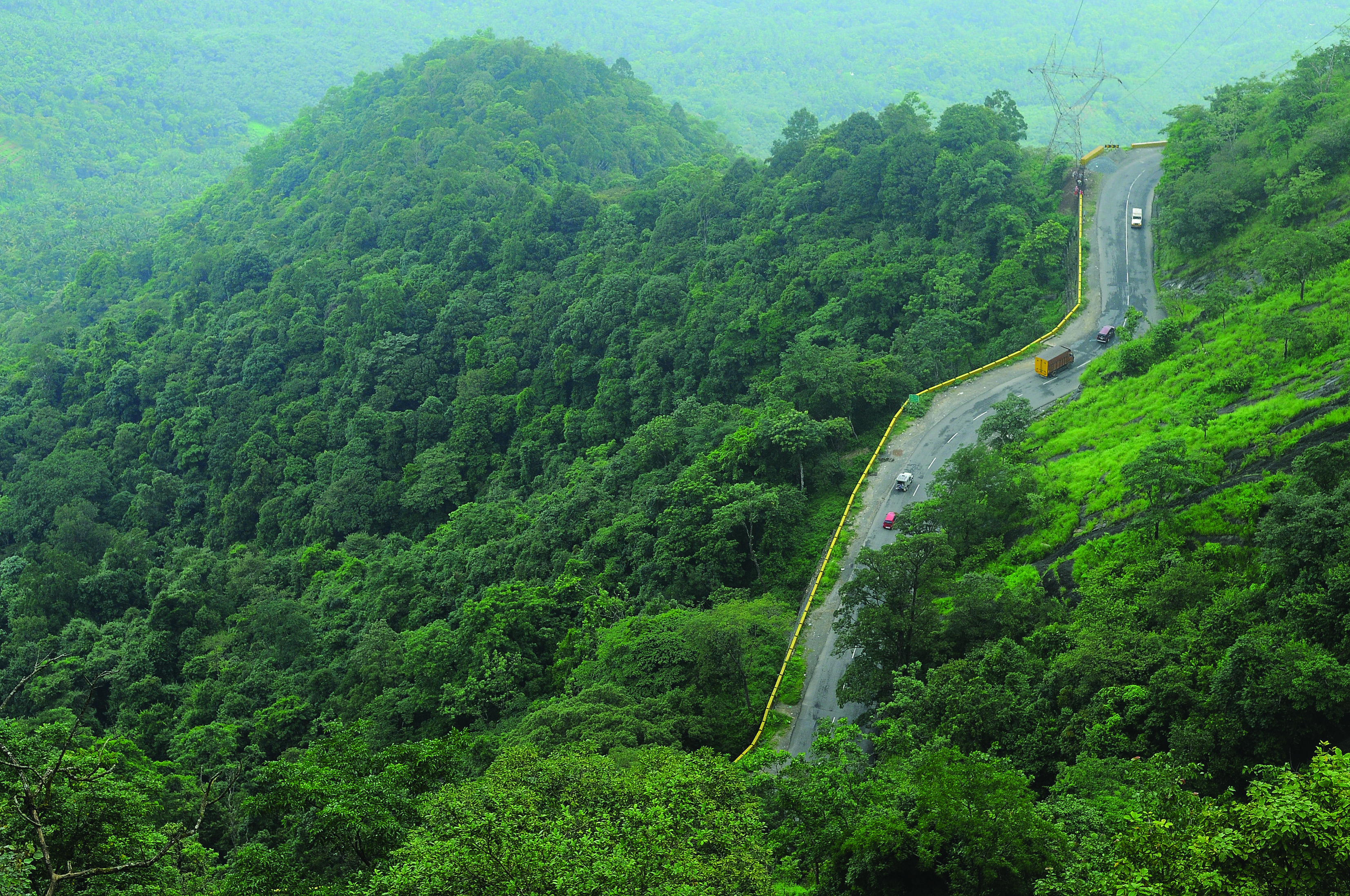
There is a road that climbs from the Malabar coast into the sky. It begins at Adivaram — a quiet junction at the base of the Western Ghats — and rises through fourteen kilometres of curves, mist, forest and birdsong until it reaches Lakkidi, the gateway to Wayanad, at 800 metres above sea level. Nine hairpin bends. Nine chances to marvel at the view, to grip the steering wheel tighter, to understand why this pass — the Thamarassery Churam — has always felt like a threshold between two worlds.
Every driver who makes this crossing — every truck driver hauling cardamom down from the highlands, every tourist bus breathing diesel through the curves, every local family returning home from Kozhikode — passes a tree. It stands near the top of the ghat, chained in iron, with a small temple at its feet. Most stop. They offer a coconut, a coin, a prayer. They are praying to Karinthandan.
This is his road. He paid for it with his life. His story is one of the oldest, deepest, and most alive legends in all of Kerala.
The World Before the Road
To understand Karinthandan's story, you must first understand what Wayanad was before the British arrived — and why crossing into it was nearly impossible for those who didn't know the land.
In the early to mid-1700s, Wayanad was one of the most inaccessible and ecologically intact landscapes in peninsular India. Bounded on the east by the Nilgiri hills of Tamil Nadu, on the north by Coorg in Karnataka, and on the west by the steep face of the Western Ghats, the district sat like a secret kept by mountains. Its forests — dense, multilayered, perpetually wet — were among the richest in South Asia: a labyrinth of rivers, ravines, elephant trails, leopard territories and tribal paths known only to those who had lived within them for generations.
The British East India Company was well aware of Wayanad's strategic and commercial value. The region's highlands were covered in pepper, cardamom, nutmeg and coffee — spices that the European market was ravenous for. Beyond that, the forests of Wayanad lay on the route to the territories of Tipu Sultan, the powerful ruler of Mysore, whose kingdom the Company was determined to subdue. But the Ghats stood in the way: sheer, forested, treacherous, and without any road that a British expedition with equipment and horses could traverse.
The British Viceroy issued a reward — documented in local oral tradition and some colonial records — for anyone who could find a viable route from Thamarassery in Kozhikode district to the Wayanad plateau above. Many tried. Englishmen who set out without local guidance fell prey to wild animals, became lost in the forest, or turned back before reaching the summit. The forest had its own defences, and those defences were ecological, not military.
Karinthandan — The Man Who Knew the Mountain
Into this landscape, and into this problem, stepped Karinthandan. He was a Moopan — a chieftain — of the Paniya tribe, the oldest and largest of Wayanad's Scheduled Tribes. He lived in the Adivaram region, at the very base of the ghat, and he knew the mountain in the way that only a person raised on its flanks can know a place: not as a map, but as a body of knowledge accumulated across generations, refined by daily movement, sharpened by survival.
Karinthandan — the name itself is atmospheric. In Malayalam, kari means black or dark, and thandan is a variant of the title for a male elder or leader. He was the dark chieftain, the black elder — a name that carries both physicality and authority. He knew every stream that became a route, every ridge that was passable in the monsoon, every trail that avoided the territories of wild elephants. The forests of Wayanad were his ecological library, and he was its most accomplished reader.
When a British engineer — his name lost to time, or perhaps never considered worth recording — came to Adivaram seeking someone who could show him the path through the Churam, the community pointed to Karinthandan. He agreed to guide them.
"The forest never betrays those who belong to it. It was the men Karinthandan trusted with that knowledge who betrayed him — and in doing so, created a ghost that no road could outrun."
— Paniya oral tradition, as recorded by PEEP (People's Action For Educational and Economic Development of Tribal People)The Journey Through the Churam
The expedition that Karinthandan led through the Thamarassery forest was not simply a walk up a hill. The terrain between Adivaram and Lakkidi is brutal — steep, slippery, criss-crossed by streams that flood in rain, laced with the trails of elephants and leopards, cloaked in mist that can descend without warning and reduce visibility to metres. To lead a group of British engineers with surveying equipment through this landscape without loss of life required extraordinary skill.
Karinthandan led them through. He knew which paths were passable, which streams could be forded, which sections of forest opened into ridgelines that gave a clear view of the route ahead. He guided the expedition from the base at Adivaram, through nine hairpin-equivalent segments of forest trail, to the plateau at Lakkidi — revealing the route that the British had spent years and lives trying to find.
At the summit, at Lakkidi, the British engineer had what he needed. He had the route. He had the grades. He had the survey data to build a road.
And there, at the moment of success, he made his calculation.
The Betrayal
The details of Karinthandan's death vary across the oral tradition — shot in the chest, pushed from a cliff, killed in a struggle — but the essential fact does not vary: the British engineer killed Karinthandan at the summit of the pass, after the route had been found and the knowledge extracted.
The motive in the oral tradition is consistent: the engineer wanted the reward the Viceroy had promised. He wanted the credit for discovering the route. And a living Karinthandan — a witness who could testify that it was a Paniya tribal chieftain who found the way, not an English engineer — was a complication. Some versions add a more damning element: that as Karinthandan realised the road's completion would bring waves of colonial extraction to Wayanad, he asked the British to stop the road, to keep the forest closed. The British refused. In the struggle that followed, he was killed.
His body was found by his people days later, far from Adivaram, at the high point of the mountain he knew better than any living person.
The Haunting — and the Chain
The British built the road. The Thamarassery Churam was constructed through the route Karinthandan had shown, and the spice trade from Wayanad to the Beypore Port on the Malabar Coast intensified almost immediately. Colonial extraction — timber, cardamom, pepper, labour — flowed down through the nine hairpin bends on a road built on a murdered man's knowledge.
And then the accidents began.
In the years following the road's construction, the Thamarassery Churam became notorious for mishaps. Travellers reported strange disturbances in the night. Carts overturned without explanation. Animals panicked. People got lost on a road that should have been straightforward. The tribal communities of Adivaram had no doubt about the cause: the spirit of Karinthandan — betrayed, unmourned, unavenged — was restless on the road he had died to create.
The colonial administration, alarmed enough by the accident rate to take the local belief seriously, called in a manthravadi — a priest skilled in ritual appeasement — from the Malabar region. What followed was a ceremony that has no equivalent in any British colonial record because no colonial administrator would have thought to document it: the priest captured the spirit of Karinthandan and bound it to a large Ficus tree at Lakkidi with iron chains. He commanded the spirit to remain within the tree and not to harm travellers.
The accidents stopped. And the chains remained — growing with the tree, wrapping deeper into its bark with each passing decade, so that today the iron and the wood have become a single organism: the Changala Maram — the Chain Tree of Lakkidi.
"No driver forgets to stop at the Chain Tree. They may not believe in ghosts — but they believe in Karinthandan."
— Local saying among Thamarassery Churam truckersFrom Spirit to Deity — The Changala Muneeswaran Kovil
The transformation of Karinthandan from a martyred tribal chieftain to a deity is one of the most organic processes in Kerala's folk religion. It did not happen through a theological decision or a religious institution — it happened through grief, guilt, and the persistent need of the road's travellers for protection.
Over decades, a small temple — the Changala Muneeswaran Kovil — was built adjacent to the Chain Tree. The deity enshrined within it is Karinthandan himself. Truck drivers, KSRTC bus drivers, private car owners, motorcyclists — nearly every vehicle that climbs the Thamarassery Churam stops at the temple. Coconuts are broken. Incense is lit. A brief prayer is said — sometimes formal, sometimes just a nod of the head toward the chained tree. Then the driver gets back in the vehicle and continues the ascent.
It is one of the most democratic acts of devotion in Kerala: a Hindu and Muslim truck driver praying side by side to a tribal spirit, a spirit whose entire story is a critique of colonial exploitation and the betrayal of indigenous knowledge. Nobody seems to find this contradictory. The road is dangerous, Karinthandan is its guardian, and the ritual of acknowledgement costs nothing and might save a life.
Today, the Paniya community holds the Karinthandan Smriti Yatra — a memorial march — every year on the second Sunday of March. Organised by PEEP (People's Action For Educational and Economic Development of Tribal People), the procession moves from Lakkidi down to Adivaram, retracing the path in reverse — from the site of the murder back to the community Karinthandan came from. Thousands of Paniya people from across Kerala participate. The Paniya community has also demanded that the ghat road be officially renamed the Karinthandan Memorial Ghat Road, and that a statue of their chieftain be installed near the Chain Tree.