Kerala's Greatest Celebration
What Is Onam — and Why Should You Travel for It?
Every September, the state of Kerala transforms. Streets disappear beneath elaborate Pookalam — flower carpets of extraordinary geometry and colour. Rivers fill with the thunder of 100-oarsmen snake boats racing in perfect synchrony. Streets become stages for Pulikali — men painted head-to-toe as tigers dancing through ecstatic crowds. Every home, regardless of religion or caste, lays a banana-leaf feast of 26 or more dishes for family and neighbours. And over all of it presides the legend of King Mahabali — a beloved demon king who was so just and generous that even the gods were jealous — who returns once a year to walk among his people during Onam.
Onam is Kerala's most distinctive cultural event and one of South Asia's most spectacular festivals for international visitors. It is celebrated over ten full days in the Malayalam month of Chingam (August–September) and is officially Kerala's State Festival. Unlike many festivals that require insider knowledge or religious affiliation, Onam is radically inclusive — it is celebrated identically by Hindus, Muslims, Christians and people of no faith throughout Kerala. Every traveller is welcome at every table.
In 2026, Onam runs from August 16 to August 26, with the most sacred day — Thiruvonam — falling on August 26, 2026. This is the perfect window for an extraordinary Kerala journey.
The Legend
King Mahabali — The Legend Behind Onam
To understand Onam, you must understand Mahabali — one of the most beloved figures in Kerala's mythological imagination. Mahabali was a demon king (Asura) who ruled Kerala in what people called a golden age: no poverty, no discrimination, no disease, no dishonesty. Every subject was treated equally. The land was abundant. There were no locks on doors because there was no theft. There were no tears because there was no sorrow. People were so happy that even the gods grew jealous of this demon king who had created a more just world than they could.
The gods persuaded Lord Vishnu to take the form of Vamana — a dwarf Brahmin — who appeared before Mahabali and asked for three paces of land. The generous king agreed. Vamana then grew to cosmic proportions, covering heaven and earth in two steps. For the third step, Mahabali — understanding that this was the divine — offered his own head. Vamana pushed him down to the underworld.
But even in defeat, Mahabali's virtue was recognised. Vishnu granted him one boon: to return to his beloved people once a year. That annual homecoming is Onam.
Maveli naadu vaanidum kaalam, maanusharellarum onnupole — When Maveli ruled the land, all human beings were equal. There was neither anxiety nor sickness. Children never cried. There were no lies. No cheating. No poverty.
Maveli Naadu Vaanidum Kaalam — the ancient Onam song sung across Kerala during the festivalThis origin story is why Onam transcends religion in Kerala. The festival celebrates not a god but an ideal — a just, equal society where every person is cared for. Every Onam feast, every flower carpet laid at dawn, every lamp lit in the evening is an act of welcome for their beloved king's homecoming. Mahabali is everywhere during Onam, depicted as a plump, benevolent figure with a golden crown.
Festival Calendar
The Ten Days of Onam — Day by Day
Each of the ten days of Onam has its own name, ritual significance and celebration. Here is what happens across Kerala during each day of the 2026 season:
🌸 Onam 2026 — Ten Sacred Days
Day 1 Highlight
Athachamayam — The Grand Opening Procession
Onam begins with one of the most visually spectacular processions in all of India. The Athachamayam — held annually in Tripunithura (part of greater Kochi) on Atham day, the first day of Onam — is a six-hour royal procession that brings together over 100 organisations, floats, cultural groups, elephant contingents, musicians, martial artists and performers in a single thundering celebration of Kerala's heritage.
The procession traces its origins to the ancient Cochin royal dynasty and features caparisoned elephants carrying golden umbrellas, performers in elaborate period costumes, Kalaripayattu martial arts demonstrations, Kathakali make-up artists applying their craft in public, Chenda Melam percussion ensembles, and dozens of floats depicting scenes from Kerala's mythology and history. It draws over 200,000 spectators and is broadcast live across Kerala.

- When: Atham day — August 16, 2026. Procession runs approximately 8 AM to 2 PM
- Where: Tripunithura Hill Palace, Ernakulam district — 10 km from Kochi city centre
- How to reach: KSRTC buses from Ernakulam; auto-rickshaw or taxi from Kochi. Arrive by 7 AM to secure a good viewing position
- Nearest accommodation: Kochi (Ernakulam) — wide range of options from guesthouses to luxury hotels
- Tip: The final hour of the procession (around 1–2 PM) is the most elaborate. Bring sun protection — the route is largely exposed
Living Art
Pookalam — The Art of the Flower Carpet
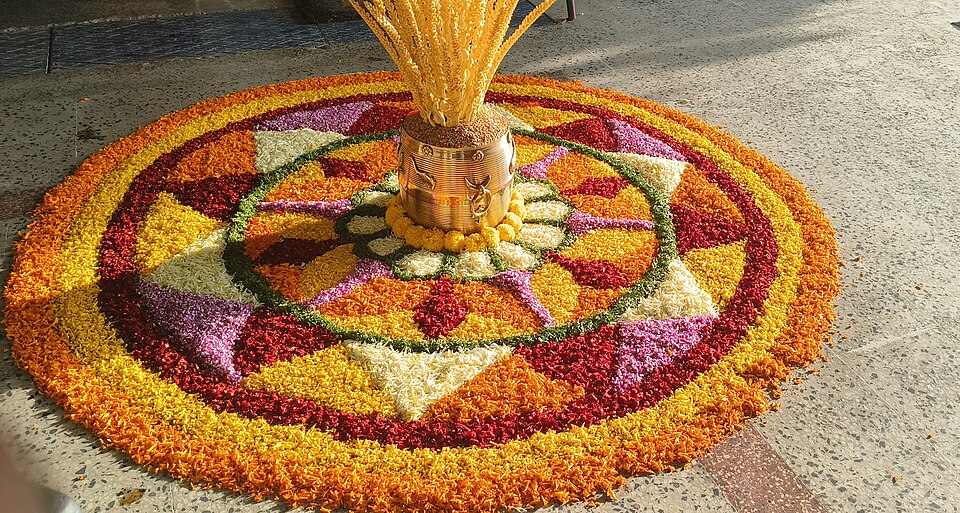
Every morning of Onam, across every home in Kerala, a Pookalam (flower carpet) is laid fresh in the courtyard or front yard. Starting with a small, simple design on Day 1 (Atham), the Pookalam grows in size and complexity each day, reaching its most elaborate form on Thiruvonam — the tenth day when King Mahabali is believed to arrive.
Traditional Pookalam uses only fresh flowers — predominantly yellow Kanikonna (Golden Shower), white thumba, red chembarathi (hibiscus), and the essential yellow Konna blossoms. Flowers are carefully sorted and arranged in concentric geometric patterns, often incorporating hundreds of thousands of individual petals in a single design that may take a family all morning to complete. The most elaborate competition Pookalam — made by professional artists for the annual competition at Thiruvananthapuram — can span 100 metres and take teams of 50 people working for days.
At the centre of most Pookalam stands the Nirapara — a traditional wooden measuring pot filled with paddy, topped with coconut and a golden lamp — symbolising the abundant harvest of Mahabali's reign.

Vallam Kali
Nehru Trophy Boat Race — Kerala's Greatest Spectacle
No single event in Kerala draws the world's attention quite like the Nehru Trophy Boat Race — held annually on the second Saturday of August on Punnamada Lake in Alleppey (Alappuzha). In 2026, the Nehru Trophy falls on August 8, 2026 — a week before Onam begins, making it a perfect addition to a September Onam itinerary by arriving in Kerala a few weeks early.
The centrepiece of the race is the Chundan Vallam — the snake boat, a 100–120 foot long war canoe with a dramatically curved stern that rises like a cobra's hood above the water. Each snake boat is rowed by over 100 oarsmen who move in perfect synchrony to the rhythm of Vanchipattu — traditional rowing songs. The sight of a dozen of these magnificent boats thundering down Punnamada Lake side by side, with 100+ men rowing in unison and tens of thousands of spectators screaming from the banks, is one of the most exhilarating experiences in all of South Asian travel.
The race was inaugurated in 1952, who reportedly threw his gold medal into the water during his visit to Alleppey — inspiring the trophy. Today it is broadcast live across India and watched by millions globally.

- Date: August 8, 2026 (second Saturday of August)
- Venue: Punnamada Lake, Alleppey (Alappuzha)
- Tickets: Gallery seats and floating pontoon tickets available from the District Tourism Promotion Council (DTPC), Alleppey. Book 4–6 weeks in advance
- Best viewing: A hired houseboat moored near the course gives the most spectacular up-close view — book 3+ months ahead for Boat Race weekend via Booking.com
- Guided tours: Join a Viator guided boat race day tour from Kochi — includes transport, prime viewing access and commentary
- How to reach: Alleppey is 53 km from Kochi; KSRTC buses, private taxis and trains from Kottayam and Ernakulam
Sacred Race
Aranmula Vallam Kali — The Sacred Boat Race
While the Nehru Trophy is the most famous boat race, the Aranmula Vallam Kali (snake boat race at Aranmula) is the most sacred — the oldest of Kerala's water festivals, held annually on the Uthradom day of Onam (the day before Thiruvonam) on the Pamba river opposite the Aranmula Parthasarathy Temple.
Unlike competitive races, the Aranmula Vallam Kali is a religious ritual — each snake boat represents a different village that has historically been in service of the Aranmula Parthasarathy Temple (dedicated to Lord Krishna). The boats carry consecrated offerings (Thiruvona Sadhya) to the temple as acts of devotion. The race that unfolds is simultaneously a profound religious offering and one of the most extraordinary sporting spectacles in Kerala.
Aranmula town is also famous for the Aranmula Kannadi — a unique metal mirror made from a secret bronze alloy known only to a small community of artisans in the town — and for being one of the Navaratna (eight sacred Krishna temples) of Kerala.


Street Theatre
Pulikali — The Tiger Dance of Thrissur
On the fourth day of Onam (Nalumonam — the day after Thiruvonam), the streets of Thrissur erupt in one of the most visually extraordinary folk art performances in India. Pulikali — literally "tiger play" — involves hundreds of male performers whose bodies are painted head-to-toe with vivid, elaborate tiger and leopard designs. These painted performers dance through the streets of Thrissur for several hours, accompanied by Thakil and Chenda drum ensembles, drawing crowds of hundreds of thousands of spectators.
The painting of each performer takes trained artists 5–8 hours using non-toxic body paint. The results are extraordinary — intricate striped patterns, spotted markings, ferocious facial expressions, golden claws and tail appendages. The finished performers are nearly indistinguishable from giant cats in motion. The performance is raucous, joyful and completely uninhibited — performers chase children, pose for photographs with tourists and engage the enormous crowd in their theatrical feline world.
Pulikali is believed to derive from an ancient tradition in which hunters celebrated a successful tiger hunt during the harvest season. Today it is Thrissur's most iconic Onam tradition and one of Kerala's most globally photographed events.

Classical Dance
Thiruvathirakali — The Dance of the Full Moon
Thiruvathirakali is one of Kerala's most graceful classical folk dances — performed during Onam (and on the festival of Thiruvathira in December) by groups of women in white kasavu sarees with golden borders, dancing in a circle around a traditional lamp or a decorative arrangement of bananas and flowers.
The dancers move in a smooth, hypnotic rotation, clapping in complex rhythmic patterns and singing Thiruvathira pattu — devotional songs praising Lord Shiva and the ideal of conjugal love. The movements are relatively simple but executed with extraordinary grace — the emphasis is on the collective movement of the group rather than individual virtuosity. The white sarees and golden light of the lamps create a visual experience of remarkable purity and beauty.
Thiruvathirakali is performed throughout Kerala during Onam — in temple courtyards, school grounds, community halls and on public stages. International visitors who have witnessed it describe it as one of the most calming and beautiful spectacles of the entire festival.

The Grand Feast
Onam Sadya — The World's Greatest Vegetarian Feast
No description of Onam is complete without its centrepiece — the Onam Sadya, a vegetarian feast served on a banana leaf on Thiruvonam day that is widely considered the world's greatest single-day communal meal. Every family in Kerala, regardless of religion, serves the Sadya on Thiruvonam — making August 26, 2026 a day when millions of banana-leaf feasts are laid simultaneously across the state.
The Sadya consists of 26 or more traditional dishes, all strictly vegetarian, arranged on a single banana leaf according to a precise protocol — sweet dishes on the left, savouries on the right, rice in the centre. Everything is eaten with the right hand only. The meal begins with the pappadom (rice crackers) and progresses through an extraordinary sequence of flavours — sour, sweet, salty, astringent and pungent — that reflects the classical Ayurvedic principle of a complete meal serving all six tastes.
- Homestay Sadya: The most authentic experience — book a traditional Kerala homestay that includes the Thiruvonam Sadya via Booking.com Kerala homestays. Your host family will treat you as a guest of King Mahabali himself
- Hotel Sadya: All major hotels across Kerala serve a full Sadya on Thiruvonam. Book well in advance — the KTDC (Kerala Tourism) hotels at Thiruvananthapuram, Kochi and Thrissur are excellent options
- Community Sadya: Many Kerala temples and community organisations host free or donation-based public Sadya — ask your guesthouse host where the nearest one is
- Onam cultural programmes: Government-organised events at major venues include live Sadya service open to the public
Planning Your Visit
Where to Celebrate Onam — Best Destinations by Event
Kerala is a state-wide festival during Onam — every town and village celebrates. But certain destinations offer signature events that no visitor should miss:
Trip Planning
The Perfect 10-Day Onam Itinerary
Here is a curated responsible travel itinerary that combines the best Onam events with Kerala's greatest natural and cultural destinations:
Travel Essentials
Onam Travel Tips for International Visitors
When to Book
Onam is Kerala's busiest tourism period. Book all accommodation 3–4 months in advance — particularly houseboats in Alleppey, which sell out 6+ months ahead for the Nehru Trophy race weekend and Thiruvonam. Flights into Kochi and Thiruvananthapuram also reach peak prices from late August.
* Affiliate links — booking through these supports Kerala Nature Vibes at no extra cost to you.
What to Wear
Onam has its own dress code. Locals wear Onakkodi — new clothes gifted by parents and family — traditionally the white and gold kasavu (Kerala handloom) for women and a white mundu with gold border for men. Visitors are warmly welcomed in these traditional garments — and any quality kasavu saree or mundu-and-shirt set bought from a Kerala handloom shop will be genuinely appreciated. Light, breathable cottons are practical for the warm September weather.
Responsible Festival Tourism
- Ask before photographing performers, particularly at religious events and Pulikali
- At the Onam Sadya, wait to be seated and follow the lead of your hosts — there is precise protocol for how the feast is served and eaten
- Use public KSRTC transport to major events where possible — private vehicles cause severe congestion at Athachamayam and Pulikali
- Support local artisans — the Onam shopping season is the most important for Kerala's handloom and traditional craft communities
- Do not waste the Sadya — in Kerala tradition, wasting food at the Onam feast is deeply inauspicious
| Event | Date 2026 | Location | For Visitors |
|---|---|---|---|
| Nehru Trophy Boat Race | Aug 8, 2026 | Alleppey (Punnamada Lake) | Book tickets 6 weeks ahead |
| Athachamayam Procession | Aug 16, 2026 | Tripunithura, Kochi | Arrive 7 AM · Free entry |
| Pulikali Tiger Dance | Aug 19, 2026 | Thrissur (Swaraj Round) | Crowd of 200,000+ · Plan ahead |
| Aranmula Vallam Kali | Aug 20, 2026 | Aranmula, Pathanamthitta | Religious event · Respectful dress |
| Thiruvonam — Onam Sadya | Aug 26, 2026 | Everywhere in Kerala | Book homestay Sadya in advance |
| Grand Pookalam Competition | Aug 26–27, 2026 | Thiruvananthapuram | Free public entry |
Onam is an extraordinary cultural treasure. As an international visitor, your respectful participation enriches rather than diminishes it:
- Stay in community-owned guesthouses and family homestays — your money flows directly to Kerala families during their most important festival
- Buy Onam gifts — kasavu sarees, Aranmula Kannadi mirrors, Kerala spices — directly from artisan cooperatives, not airport souvenir shops
- Learn at least one line of the Onam song — any Keralite will be moved by a visitor who knows Maveli naadu vaanidum kaalam
- Ask your host to teach you the proper protocol of eating the Sadya — it matters, and they will be delighted to show you
Explore Kerala Beyond Onam
Onam is the perfect time to combine Kerala's festival calendar with its extraordinary natural landscapes. These guides from Kerala Nature Vibes pair perfectly with an Onam trip:

Common Questions